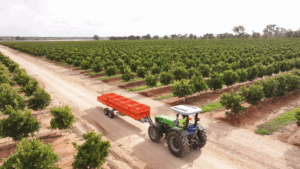
Handling bulk produce safely, cleanly, and efficiently is a constant focus for growers, packhouses, and processing facilities. Forklift attachments play a major role in this process, particularly when it comes to emptying produce bins into hoppers, grading lines, or trucks.
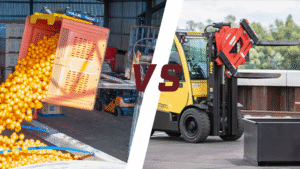
Two common attachment types used across horticulture and agriculture are forward bin tippers and bin rotators. Both are designed to empty bins using a forklift, but they achieve this in very different ways. The differences directly affect safety, cleanliness, operating flexibility, and total cost over time.
This article compares both systems, with a strong focus on practical outcomes seen in real operating environments.
What Is a Forward Bin Tipper?
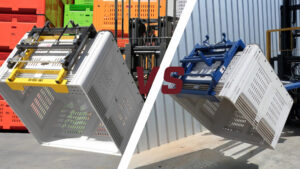
A forward bin tipper slides over standard forklift tines and tips the bin forward from its front edge. The attachment typically uses a hydraulic ram connected to the forklift auxiliary hydraulics.
The key characteristic is the forward tipping motion, which pushes produce away from the forklift and toward the receiving target such as a hopper or trailer.
What Is a Bin Rotator?
A bin rotator mounts directly to the forklift carriage and rotates the bin sideways around its centre point. Many systems require rotating bars fitted to the underside of the bin so the rotator can grip and turn it.
This creates a sideways rotation motion rather than a forward tipping motion.
Key Reasons Many Operations Choose Forward Bin Tippers
Greater Reach from the Forklift
Forward bin tippers extend the tipping point further away from the forklift. This means operators do not need to drive right up beside a hopper, trailer, or truck to empty the bin.
This has two major effects:
- Reduced collision risk
More distance between the forklift and fixed structures reduces accidental contact. In busy packhouses or field loading areas, this can significantly reduce damage risk to forklifts, buildings, and receiving equipment. - Cleaner produce handling & hygiene
The produce is moved further away from the forklift mast, chains, and fork carriage. These areas can carry grease, dust, or field contaminants. Increasing distance lowers the chance of anything falling into the produce stream.
Flexibility Across Multiple Machines
Forward bin tippers are slip-on attachments.
They can be:
- Installed without modifying the forklift
- Moved quickly between forklifts
- Used on tractors with fork masts
- Used on skid steers with fork attachments
This allows one attachment to service multiple machines across a site or across multiple sites.
Rotators, in contrast, are normally carriage mounted. Removing and refitting them takes more time and usually requires workshop tools. In many cases they stay dedicated to one forklift.
For operations running mixed fleets or seasonal machinery, the slip-on design provides strong operational freedom.
Lower Total Cost in Real World Use
On initial purchase price alone, rotators are often similar in cost to forward bin tippers, sometimes higher. The major difference appears when bin compatibility is considered. Most bulk produce bins used across Australia have open tine pockets. Forward bin tippers work with these bins immediately.
However, many rotator systems require rotating bars fixed to the underside of each bin.
Example impact:
- Nally MegaBins rotating bars adds approximately $100 per bin
- Large operations may run hundreds or thousands of bins
This creates a large additional capital cost.
There is also a mechanical risk factor. When steel bars are fixed into plastic bins, repeated loading and rotation can stress the plastic around the mounting points. In some cases, this can lead to a joint failure and the bin will fall.
Forward bin tippers avoid this completely because they work with standard bin designs and have multiple points of contact over a larger surface area.
More Accurate Discharge Pattern
Rotators rotate around the centre of the bin. As the produce exits, it tends to spread across a wider discharge area.
Forward bin tippers pivot from the front edge of the bin. This creates a tighter, more controlled discharge stream.
Practical benefits include:
- Less spillage on floors
- Better targeting into narrow hopper openings
- Cleaner working areas
- Less time spent on cleanup
In packhouse environments where floor cleanliness matters for safety and hygiene, this can have measurable operational value.
Where Rotators Can Still Be Suitable
Rotators can still suit certain applications, for example:
- Operations already fully set up with rotating bar bins
- Sites with dedicated forklifts assigned to fixed tasks
In these cases, rotators can perform reliably when matched to the right setup.
Final Considerations
Choosing between a forward bin tipper and a rotator usually comes down to how flexible, safe, and cost controlled you want your operation to be.
Forward bin tippers typically offer:
- More stand off distance from structures
- Cleaner produce handling
- Faster attachment swapping
- Lower bin modification costs
- More controlled discharge placement
For many growers, packhouses, and bulk produce handlers, these factors make forward bin tippers a very practical long-term solution.